1 March 2026
How Khadim N. Diaye’s Experience with Laser Spray Rain Pipe
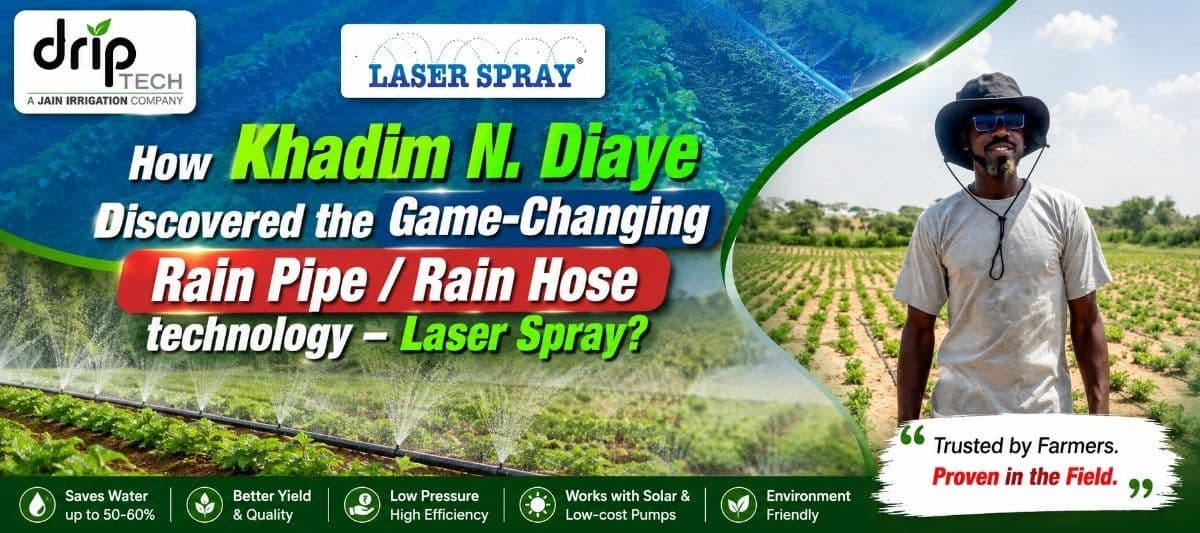
How Khadim N. Diaye Discovered the Game-Changing Rain Pipe / Rain Hose technology - Laser Spray?
A rain pipe (also called a rain hose) is a type of irrigation pipe used in farming to simulate rainfall. It is a perforated plastic pipe that releases water in small holes, creating a rain-like spray over crops. There are many brands of rain pipe / rain hose are available in the market, and choosing the right one can be challenging for farmers due to differences in quality, durability, and water distribution efficiency.
Khadim N. Diaye, a progressive farmer from Njalaxar, Saint Louis, Senegal, West Africa (Contact No. +221 778176535), experienced this challenge firsthand. He experimented and in the process, discovered a game changing rain pipe technology Laser Spray!
Experiment with Rain Pipe / Rain Hose and Laser Spray
Khadim Diaye manages a farm where he cultivates different crops in separate plots. To compare irrigation performance, he used two different systems side by side. In one plot, he cultivated peanuts using Laser Spray irrigation. In the adjacent plot, he grew watermelon using a conventional rain pipe / rain hose system. This real-time comparison gave him clear insights into the performance difference between the two irrigation methods.
Laser Spray Covers More Area with Less Quantity
One of the most striking differences observed was in the coverage of land:
- In the watermelon field using ordinary rain pipe / rain hose, the pipes had to be laid at intervals of 2 meters.
- In contrast, in the peanut field with Laser Spray, the spacing between pipes wide as 5 meters was workable. Even at 5 meter spacing Laser Spray was irrigating the plants better. The plants were wet uniformly so that the leaves are properly cleaned which was not happening in case of the filed irrigated by ordinary rain pipe.
How is this technically possible and what benefit it brings to the user farmer?
The answer lies in technological excellence. Laser Spray is designed to cover a wider area per roll than most ordinary Rain Pipes or hoses. Because of its wider coverage, the tubes can be placed at longer intervals across the field. In simple terms, fewer rolls can irrigate the same area as multiple rolls of an ordinary Rain Pipe / Rain Hose. So, you need less quantity of the spray tube. For 1 acre of land, only 600 mtr of Laser Spray 32mm / 40 mm is sufficient. This is almost half of the quantities you normally need for an ordinary rain pipe / rain hose and directly reduces the cost of the irrigation system. The images below explain this more clearly:

Figure 1
Saving in other components of the irrigation system
The advantages of Laser Spray go beyond just pipe quantity. Khadim N. Diaye also made the following observations:
- Laser Spray pipes were able to cover up to 50 meters in length i.e. they were giving uniform discharge till 50 mtr length of the pipe.
- The ordinary rain pipes could cover only about 25 meters.
Laser Spray can be laid out over longer distances than ordinary Rain Pipes / Rain Hoses. It has a higher Maximum Permissible Length, meaning each spray tube can irrigate uniformly over a longer stretch without loss of water discharge volume beyond standard acceptable range. Please see the figure 1 above.
This reduces the quantity of Main Line Sub-Main Lines and fittings for Laser Spray system because you have to place a submain at the end of the Max Permissible Running Length and feed that sub-main with a extended main line. The diagrams below illustrate a spray irrigation system for 1 hectare with Laser Spray and Ordinary Rain Pipe / Rain Hose. You can see that the system with Laser Spray has lesser quantity of the followings
- Main Pipe
- Sub Main Pipe
- Ffittings like Valves and End Caps
This reduction in components directly lowers installation complexity and overall system cost.


Economic Advantage of Laser Spray
From an investment perspective, This reduction in components directly lowers installation complexity and overall system cost. observed that Laser Spray is more cost-effective. Although individual Laser Spray pipes may appear costlier, the total system cost becomes lower due to:
- Reduced number of spray pipes
- Lesser requirement of pipeline infrastructure
- Lower number of fittings
This makes Laser Spray more economical solution for farmers.
Other Advantages of Laser Spray
Uniform Coverage: Khadim Diaye also observed that Laser Spray was cleaning the leaves properly in the entire field. This was due to its superior spray pattern, it cover the field properly and uniformly with the irrigation. Laser Spray ensures even distribution of water across the field, improving crop health and growth.
Farmer’s Experience and Observation By observing both fields side by side, Khadim Diaye clearly noticed the advantages of Laser Spray over conventional rain pipes. Please see this video on Khadim N. Diaye’s experience:

https://www.youtube.com/watch?v=gkQt7XmSgJQ
Conclusion
Khadim N. Diaye’s experience highlights why Laser Spray is gaining popularity among farmers across Africa and beyond. It delivers better performance and has huge cost advantage because it needs lesser spray pipes, main and sub-main pipe and fittings.
Frequently Asked Questions (FAQs)
What is Laser Spray?
Laser Spray is an advanced Rain Pipe / Rain Hose irrigation technology that uses laser-punched holes to distribute water uniformly across the field.
How is Laser Spray different from ordinary Rain Pipe?
Laser Spray is designed to provide wider coverage, finer droplets and more uniform irrigation, potentially allowing greater spacing between irrigation lines.
Does Laser Spray reduce irrigation costs?
It can reduce total system cost by requiring fewer spray pipes, main and sub-main lines, and fittings, depending on the field layout.
What did Khadim N. Diaye observe?
In his field comparison in Senegal, Khadim N. Diaye observed wider coverage and more uniform irrigation with Laser Spray compared with the ordinary Rain Pipe system he tested.
1. What is Laser Spray?
Laser Spray is an advanced irrigation system that uses laser-punched technology to distribute water uniformly across the field in the form of fine droplets, similar to natural rainfall.
2. How is Laser Spray different from an ordinary rain pipe?
Laser Spray provides wider coverage, uniform water distribution, and finer droplets, while ordinary rain pipes often have uneven pressure and limited coverage.
3. How can fewer Laser Spray pipes irrigate the same area?
Laser Spray covers a larger area per pipe due to its superior spray pattern, allowing wider spacing between lines and reducing the total number of pipes required.
4. Does Laser Spray provide uniform irrigation?
Yes, Laser Spray ensures uniform water distribution from start to end, so every plant receives equal moisture.
5. Can Laser Spray save water?
Yes, Laser Spray helps in significant water saving because it distributes water efficiently and avoids wastage.
6. Does Laser Spray reduce overall irrigation cost?
Yes. Even though the cost per pipe may be higher, the total system cost is lower due to:
- Fewer pipes required
- Reduced main and sub-main lines
- Fewer fittings
7. Is Laser Spray suitable for small farmers?
Absolutely. Laser Spray is ideal for small farmers as it is cost-effective, efficient, and easy to install, helping maximize returns on small land holdings.
8. Are Laser Spray water droplets safe for crops?
Yes, the system produces fine droplets that do not damage delicate crops, flowers, or fruits.
9. Does Laser Spray help in improving crop growth?
Yes, uniform irrigation leads to better plant growth, healthier crops, and improved yield.
10. Is Laser Spray durable?
Yes, it is made from high-quality virgin plastic, making it strong, durable, and long-lasting.
11. What crops are suitable for Laser Spray?
Laser Spray is suitable for a wide range of crops including:
- Leafy vegetables
- Horticulture crops
- Field crops
12. Is Laser Spray used only in India?
No, Laser Spray is widely used by farmers in India, Africa, and Southeast Asia, proving its effectiveness across different regions.